Breathe and Push: How a Hawk Lured Me Out of a Dark Holler into the Creative Light

by Anne Pellicciotto

Writing my secrets has always been my secret. 

Iโ€™ve scribbled away, diligently, in the margins of my life and, by now, in my fifties, I have a fully completed manuscript. Though itโ€™s never done, is it? 

To keep the creative spark alive, over the years, Iโ€™ve taken workshops, gone away to residencies, joined critique groups, attended conferences. With the support of a writing community, and because Iโ€™ve had no choice, I kept going. Iโ€™ve written and rewritten: the very first version was a novel. I deviated to other stories, essays, blogs. Iโ€™ve always come back. 

Iโ€™ve mustered the courage to pitch to agents. Iโ€™ve gotten kind rejections. Iโ€™ve gotten silence. Iโ€™ve gotten a bite: Interesting, send it when itโ€™s fully polished and ready to go.

Itโ€™s not ready to go; it will never be ready. 

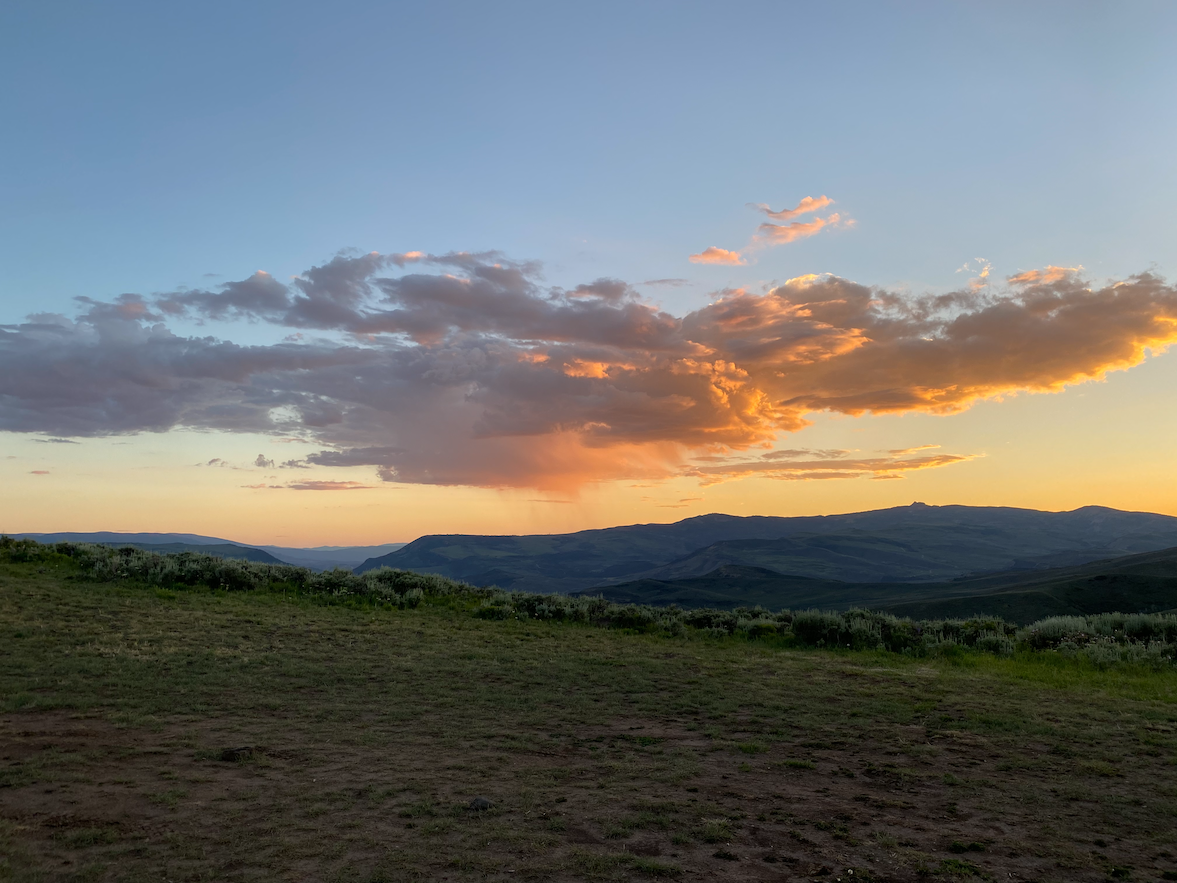
A misty October in a holler in West Virginia.
image of a West Virginia holler by Anne Pellicciotto

Then, one misty morning this past October, in a holler, in West Virginia, that hawk swooped down and caught me in the gaze of his beady yellow eye. I stopped in my tracks. Everything became still. My heart thumped in my chest as I watched him, expanse of brown and white striated wing, sail upward.

โ€œSimplicity and freedom,โ€ I whispered, as he hung above me like an untethered kite.  Then a smile, the first in ages, spread across my face.  

Iโ€™d escaped DC for a much-needed break from the pandemic and political mayhem, from the helicopters circling over my neighborhood, rattling the windows in their frames, from appalling events that had yet to unfold. Over the course of my week in the woods the panic attacks subsided, my racing heart calmed, the mind-numbing headaches waned. I slept through the night. I wrote through my days. I hiked through the fields, along the brook, taking in the scent of jasmine and decaying leaves. 

Maskless, out in nature, I could breathe.

Back in Washington, I felt immediately trapped again. This suffocating feeling was not unfamiliar to me: trapped as a kid in a home with my drunken, enraged father; confined in a young marriage that was supposed to have saved me from my imploding family. 

In middle-age, in this time of Covid, I felt a bubbling urgency, once again, to escape. 

As a professional change consultant and coach, Iโ€™d spent the past six months guiding clients โ€“ business owners, artists, solopreneurs โ€“ through their pandemic pivots. In doing so, Iโ€™d navigated my own business pivot. I ported my services online and zoomed my days away like the rest of the white-collar world. My clients were inspiring: in the face of so much adversity, many made the shift from survive to thrive.

The problem was:  I wasnโ€™t thriving. I hadnโ€™t been since way before the pandemic. The silver lining of Covid for me, one of the lucky ones who hadnโ€™t been inflicted directly, was that I could see my own fragility โ€“ and its polarity โ€“ my vitality.

The encounter with the hawk had woken me up to a glimmering possibility. But what was I supposed to do? What did simplicity and freedom mean? 

Initially, I took it to mean selling my house, divesting of my belongings, shuttering my business, and driving west across the country to seek out a new life. But that vision โ€“ along with a parade of real estate agents through my home of 22 years โ€“ only accentuated my fears. When I closed my eyes at night, the image of pulling away from Park Road, a car crammed with my earthly possessions, drifting around the wide-open west, untethered, ironically, did not feel like freedom. Instead, my chest felt constricted; the sleeplessness and anxiety returned. 

My therapist told me, frankly, โ€œAnne, youโ€™re scaring the shit out of yourself.โ€ 

I chuckled nervously. I bit my thumb cuticle bloody. Did this mean I wasnโ€™t ready? Ready for what?

I went back to my half-finished vision board for clues. The collage of pictures ripped from magazines and glued onto posterboard depicted serene scenes, isolated abodes with decks and Adirondack chairs facing vistas of water and mountains. A pink lotus flower bloomed out of the left upper corner with the word contemplate pasted above it.

When I really focused, I could see: the images were of me, very still, in quiet places. I had to close my eyes to access what was in the depths of my heart, a secret well-kept from even myself: I needed simplicity and freedom in my life to, shhhh, write.  

Even typing these words, revealing this truth to the page, felt like a betrayal, like something I should backspace and erase. But that admission โ€“ that writing has always been my passion โ€“ was a door, and I stood on the threshold.

My manuscript sits, weighed down by secrets. When will it be ready? When will I?

Itโ€™s time to double down on Monday Night Writing Salon, I tell myself. Iโ€™ll sign-up for a memoir class at the Writers Center. 

I blink my eyes shut and reopen them to my vision board, propped on the radiator. A calm river runs down the center, a kayak piercing the shady green water. A bluebird, not quite a hawk, drifts across a sunlit sky, song notes emanating from its beak.

I exhale a puff of exasperation, bend closer to the collage, brow crinkled. A woman in white dives into a tropical blue abyss. A hiker gazes across and open field toward the horizon with the message: Trails are merely suggestions.

The truth stares me in the face. 

The truth speaks to me in my dreams. The hawk opens its hooked beak and says I can.

 I donโ€™t need another writing program, a swirl of busy work, a litany of applications, rejections, submissions, decisions. 

I have but one decision to make.

I donโ€™t need a grant; I need to grant myself permission to stop zooming and go.

Writing is a story burning inside me. Writing is a decision to feed the flames.

Writing is the hawk that has reminded me, has lured me, has eyed me.

I stand at the edge of the field feeling the nudge of the breeze against my back. I take my first step through the tall grass. The ground feels firm on this path; my heart feels light. I am in motion.

The next steps are practical; this is a self-funded sabbatical. I prepare my house for rental, post an ad, field the inquiries, draw-up a lease, begin to sort through my possessions. I take another step and reserve my cabin in the woods, in the mountains, by a river, with a good desk and chair and light and air. I make those symbolic pictures real.

I have already run up against Resistance โ€“ a very familiar voice that says things like: โ€œWell, youโ€™re not a real writer,โ€ and โ€œThe world doesnโ€™t need another book,โ€ and โ€œIsnโ€™t it a little late for a career change?โ€

This time I reply sweetly, firmly: Itโ€™s never too late to become who you are. Itโ€™s never too late to be free.

Head shot of author Anne Pellicciotti standing in front of a wide expanse of water.

Anne Pellicciotto, life coach and owner of SeeChange, writes about the crossroads in life that break and make us. Heeding the hawkโ€™s message, sheโ€™s hit the road for a year of simplicity and freedom. In the void, Anne plans to complete Strings Attached, a #metoo coming of age memoir in which she marries her music teacher lover to save herself and, eventually, must break free from him. Follow her midlife coming of age adventures at www.seechangeconsulting.com/blog or on Medium at https://anneseye.medium.com/.

Submissions: The Harsh Reality and How to Improve Your Odds

By Thea Pueschel

First published by Shut Up & Write  June 3, 2021

A rejection letter leaves many writers devastated. For years, I would submit one to three pieces a year to literary magazines, and if the work received a rejection, it became dead to me. My nonfiction wellness articles had a 98% acceptance rate, leading me to believe I would have no problem getting my fiction and creative nonfiction published. I did not know about the incredibly low acceptance rates of literary magazines. 

There are finite spaces to fill in the literary world, though the internet itself seems infinite. Writers hoping to be published in top-tier literary magazines are faced with startlingly low acceptance rates. According to Duotrope, The New Yorker magazine accepted only 0.14% of 1,447 unsolicited submissions received in a year. The lower-tier magazine Split Lip received 938 unsolicited submissions that same year, and only 0.11% were accepted. 

 - Find & Share on GIPHY

Rejection feels personal, though it isnโ€™t. Itโ€™s a numbers game, even with smaller publications. To prove this, I reached out to Viva Padilla, the editor-in-chief of the annual literary magazine Dryland, and asked her about the submission statistics for her publication. โ€œThe most submissions we have ever received [for a single issue] was over 1000,โ€ she said. โ€œEvery issue has about 50-55 publishing spots available, with around 40 reserved for poetry.โ€ I did the math. That equates to an acceptance rate of 1%-1.5% for a work of fiction. For poetry, the odds are slightly better at 5%. Thatโ€™s a rejection rate of 95-99%. The acceptance rate is higher compared to Split Lip and The New Yorker, but even then most of the work is rejected due to space limitations, among other reasons.

The work Dryland publishes is primarily through open calls. Most literary magazines and journals solicit work from writers they know or those with name recognition, presenting an entry barrier to emerging or unrepresented writers. In her 2015 article for The Atlantic, acclaimed writer Joy Lanzendorfer made two interesting assertions. First, that the average published story is likely rejected 20 times before being published; second, that slush pile submissions only account for 1-2% of published work. Simply put, most of the work you see in the literary spaces is based on connection or writer recognition. Despite the rejection stats, and the reality of how many times it takes for a story to stick to a magazineโ€™s pages, this emphasizes the importance of being an active member of the writing community. Editors solicit work from people they know. To be known you have to be an active member of the literary community.

A few years ago, I became a member of Women Who Submit (WWS), a nonprofit focused on elevating the voices of BIPOC, women, and nonbinary writers. This organization helped me see behind the literary curtain. Various members have taken time to offer me guidance and mentorship through both the submission and rejection process. WWS showcases the importance of relationships and elevating each otherโ€™s voices. The reality is that writers who know writers get published more, and all editors of literary magazines are writers themselves.

Since having my eyes opened by WWS, I have become a member of other writing communities, including Shut Up and Write. Outside of my WWS bubble, I have seen that other writers in various spaces struggle with the inevitability of rejection like I did. I hope this helps reduce the sting of rejection, and I would encourage you to submit again and again until your work finds its literary home.

Recently, I received a really nice standard rejection from Zyzzyva. The last paragraph said, โ€œI would like to say something to make up for this ungraciousness, but the truth is we have so little space, we must return almost all the work that is submitted, including a great deal that interests us and even some pieces we admire. Inevitably, too, we make mistakes.โ€

I asked Christopher James, the editor-in-chief of the five-year-old Jellyfish Review, how often his magazine rejects stories they love because of lack of space. He responded, โ€œWe frequently say no to a lot of very strong stories, we would never say no to something we loved. We often accept imperfect pieces because weโ€™ve fallen in love with them and hope our readers might fall in love with them too.โ€ As the newer journal matures, they too may have to say no to work they admire. At the moment though, if they read your work and love it theyโ€™ll make space for it. Most journals have a limitation and only accept a certain amount of workโ€”Jellyfish is the exception, not the rule.

Rejection is part of the process of getting your work out into the world. Should you default to younger journals? You can, but I believe that as a writer you should submit to the journals that speak to you, the magazines that you envision as a perfect fit. Familiarize yourself with the work they publish, follow their submission guidelines, and keep submitting work that aligns with their aesthetic. It will increase your chances of acceptance.

Even though stats are against them, many writers still manage to succeed, and you could be one of them. I reached out to the writers I know and asked if anyone had received multiple rejections only for a piece to be published later. Carla Sameth, author of โ€œOne Day on the Goldline: A Memoir in Essaysโ€ shared that her personal essay, โ€œIf This Is So, Why Am I?โ€ was rejected 22 times before it was published in The Nervous Breakdown, only to be selected as notable for The Best American Essays of 2019. Just because something receives multiple rejections does not mean it isnโ€™t worthy of recognition, accolades, or publishing. It left me wondering if those other 22 magazine editors felt they missed their window and had inevitably made a mistake.

I asked Kate Maruyama, the author of my favorite novella of 2020, โ€œFamily Solstice,โ€ about her experience. Eighteen editors rejected her first novel โ€œHarrowgateโ€ before it was purchased. A short story of hers was rejected 35 times before being published. โ€œFor the short story, rejection number 10 was from Roxane Gay when she was reading for a journal,โ€ Maruyama explained. โ€œShe said it wasnโ€™t right for that journal but that it was a damn fine story.โ€ Those words of encouragement along with her writing community kept Maruyama submitting.

To improve your odds and to keep a stiff upper lip when rejection inevitably finds its way to your inbox, here are some pointers to help ease the painful experience:

Take resubmission requests seriously. If a magazine rejects a written piece of yours but asks you to resubmit, they are not being nice. They donโ€™t have time to be nice. They enjoy your work! Resubmit.

Familiarize yourself with the places you want to submit. If editors keep telling you that your work doesnโ€™t fit their publication, read the publication. If you canโ€™t access the publication because of monetary restrictions, look for copies in your local library or read the work of the writers who have recently been published by the magazine or journal. A Google search of the author will find other work of theirs that you can read for free. Compare their aesthetic to your own. Are you a fit? Then itโ€™s a good place to submit!

Make sure your work is submission-ready. This is the number one sin of writers, according to Viva Padilla. Dryland doesnโ€™t edit poetry; โ€œโ€ฆwe expect poems to be ready to go,โ€ she said. โ€œWhen it comes to fiction and nonfiction that gets rejected, itโ€™s mostly work that doesnโ€™t seem to have a focus where weโ€™re left wondering, what was that about?โ€ Workshop your work with other writers and make sure to check your grammar before you submit.

Donโ€™t expect an editor to provide feedback. If a magazine rejected you without giving a reason, pestering an editor for the โ€œwhyโ€ will quickly slam doors on future opportunities. Personalized rejections are rare. They are nice when they come in, but an editor doesnโ€™t owe you a reason.

The reality is slush piles at literary magazines are immense, and many editors are volunteers or minimally compensated. These magazines are mostly labors of love for the written word. Rejection may seem personal, but itโ€™s not. Even literary magazine editors get rejections from other publications. The more you submit, the greater the chance your work will find a literary home. The more time you take to prepare and research the best market for your work, the greater your odds for acceptance. Donโ€™t be discouraged when you get a no. Look over your work and see if there are any structural or grammatical issues. If not, submit it again ASAP. If there are errors, fix them and send your piece out again.

Bottom line: itโ€™s time to Shut Up & Submit!

Thea Pueschel is a writer, multi-media artist, and the winner of the TAEM 2020 Flash Fiction Summer Contest. Thea enjoys exploring the dark with light and the light with dark and a firm believer that without the shadow art and literature has less soul. 

Together We Thrive: Encouraging Women Through Writing and Workplace Communities

Byย Daria E. Topousis

In 2015, I felt like my whole world was coming apart. I had spent ten years writing a memoir that never came together and had finally made the hard decision to abandon it. I had returned to my first love, fiction, but all of the stories I sent out were being rejected. I was a failure as a writer. I started to wonder if I should give up on my life-long dream. And then I read an article in Poets & Writers Magazine about an organization called Women Who Submit. The story of how women stop submitting after a few rejections hit close to home, and I loved how the founders wanted to change that. I showed up to my first meeting about a year later and knew I wanted to be part of this community.ย 

Around the same time, I was floundering at work. I had worked in software at the Jet Propulsion Laboratory for twenty years. It was the lifeline that kept me financially and intellectually tethered, despite the vicissitudes of my writing life. A group of new managers were hired in my organization, and I was suddenly feeling unwelcome in the male-dominated technology world. I was starting to wonder if I should leave my software project management career altogether and find something else to do to earn a living. This struggle went on for a couple of years, and in the heart of it I went to a conference called the Grace Hopper Celebration of Women in Computing (GHC). I was blown away by how welcoming everyone was, despite the fact that it was an enormous conference (15,000 attendees that year). I went to tracks where women told stories similar to my own. By the end of the event, I decided I was not going to walk away from my career. No, I was going to stay and try to bring this spirit of support back with me. I wanted to have that encouragement and enthusiasm every day, not just once per year. So I organized a meeting of women who had attended GHC to see if they were interested in forming some kind of community at JPL.

Fifteen women showed up to our first meeting. We talked about the conference, and about how it had been a morale booster for all of us when we attended (all at different times). We decided we wanted to continue meeting, but what would we focus on? We scheduled a second meeting to figure that out. Women who had attended the first meeting started spreading the word so that by our second meeting forty people showed up. We talked about our struggles, our achievements, and suggestions for future meeting topics. I also asked if anyone would be willing to help manage the group, and several volunteered. And so Women in Tech began. 

From the beginning, we wanted to be a peer-to-peer network that would foster each otherโ€™s careers, support each other at work, and learn from each other. In dialog with some of the early members, I realized how much women in science and technology have in common with writers. Like women who give up after their writing is rejected, women will not apply for a job if they donโ€™t get it on the first attempt. An internal report at Hewlett Packard, which was widely publicized through books like Sheryl Sandbergโ€™s Lean In, showed that women wait until theyโ€™re 100 percent qualified for a position (men apply when they are 60 percent qualified) before they apply. I realized many of us were suffering from imposter syndrome and self-doubt. One of my favorite parts of Women Who Submit is the submission party: a coworking space where when someone sends a piece of writing off to a journal, everyone in the room cheers. It helps us associate positivity with the normally nerve-wracking process of sending our work into the world, and also gives us control of when and how we submit. I decided we needed something similar at JPL. I loved that submitting work had become something to brag about, as had rejections (the WWS monthly submission brag is a comment board where members can share their latest rejections for support). So, in one of our early Women in Tech meetings, we asked anyone who had taken a risk in their career to stand up. A risk could be applying for a new job, sending a paper in for a conference or peer-reviewed journal, or having a talk with your manager about your career. When the risk-takers stood up, we applauded. This was a huge success, and at our next meeting women wanted to share what kind of risk they took. After that we spent time hearing about what women were doing and celebrating their bravery. They canโ€™t control whether they get a job or whether their paper gets accepted in a peer-reviewed journal, but they can control whether or not they try. 

Soon women were approaching me at work to introduce themselves and tell me about a risk they took because they heard other womenโ€™s stories. Women were applying to be conference chairs, to be part of big initiatives in their field, and were starting to stand up for each other in meetings when they felt like another womanโ€™s voice wasnโ€™t being heard. We were encouraging each other to be brave. 

We also introduced the idea of giving a shout-out to anyone who had done something as an advocate or ally. Maybe they stood up for your ideas in a meeting. Maybe they pushed you to apply for a role you didnโ€™t think about going for yourself. We also started peer-to-peer training on impostor syndrome, negotiating for yourself, and tips for applying for jobs within JPL. 

Now, three years after starting, we have 350 members who are supporting each other, building each other up, and connecting with mentors. When the pandemic hit, we moved to virtual meetings. We now have anywhere from 75-250 people on our calls. And they arenโ€™t just women. We are also open to non-binary professionals and to any men who want to be allies. Even when we are alone in our homes working, we know we have colleagues who have our backs and who are there to lend an ear or give advice. New employees are building their networks and finding friends through our community. 

As for me, I know I will stick it out in this field. This year I celebrated my 25th anniversary working at JPL. I am still writing too. Iโ€™m sending work out, both fiction and nonfiction. I have learned to celebrate my successes and my failures. I have my confidence back and I owe it to all the amazing women in my life, both in Women Who Submit and Women in Tech. I am grateful for Women Who Submit for providing this model of how to build supportive communities that believe in a tide that raises all ships. Together we thrive.

Women writer with two tone hair and a teal shirt in front of a light colored wall

Daria E. Topousis is a prose writer and a software project manager at the Jet Propulsion Laboratory. In 2020 she received the Equal Opportunity Medal, a NASA Honor Award, for her work building Women in Tech.ย 

This work was done as a private venture and not in the author’s capacity as an employee of the Jet Propulsion Laboratory, California Institute of Technology. The content has not been approved or adopted by NASA, JPL, or the California Institute of Technology. Any views and opinions expressed herein do not necessarily state or reflect those of NASA, JPL, or the California Institute of Technology.

May Publication Roundup

As we near the end of Spring and the midpoint of 2021, our WWS members continue to thrive in the publishing world. May was an especially productive publication month for our members. I’ve included in this publication roundup an excerpt from the published pieces (if available) of members who published this month and a link (if available) to where the pieces can be purchased and/or read in their entirety.

Congratulations to all those in WWS who published work during the month of May!

Continue reading “May Publication Roundup”

Breathe and Push: Prompts for Gathering

By Noriko Nakada

Maybe youโ€™ve heard, but in case you havenโ€™t, Women Who Submit is celebrating 10 years! I mean, even Poets & Writers took notice of this badass organization and the women and nonbinary writers who are pushing against the patriarchy by supporting one another in our creative journeys.

As part of our first decade anniversary, we invite you to submit to our second anthology: Gathering. The first Women Who Submit anthology, Accolades highlights previously published work by Women Who Submit members, while Gathering celebrates how, in 2020-2021, โ€œwe continue to gather across the country, support one another, and find joy in the midst of our trauma.โ€

Gathering “welcomes submissions of both unpublished and previously published poems, essays, stories, plays, and hybrid work from all WWS members. Our goal is to gather work in response to the current conditions of our world. It is an opportunity to share the trauma and celebrate the joy.โ€

If you have already submitted, claps, claps, claps!

If you are still looking through your drafts for the right piece to submit, keep the May 31st deadline in mind.

If you donโ€™t think you have anything written yet, here are some prompts for each of our genres. Go for it! You have a whole three-day weekend to draft, revise, re-read, revise, edit again, and submit something for Gathering. Or, just write to the prompts because itโ€™s like improv and a fun exercise to jump into a different genre and write for fun for a bit.

PROMPTS

DRAMA: Write a scene between characters with an unresolved past who find themselves unexpectedly stuck in line together.

POETRY: Using recycled lines from poems youโ€™ve drafted throughout the pandemic, write a new poem and incorporate specific flora and fauna. Maybe try a villanelle or a duplex!

FICTION: Capture a scene of post-pandemic bacchanalia where a character gets lost.

NONFICTION: Write three different brief scenes capturing various points of a relationship or a place. Weave them together into an essay.

Remember to read the submission guidelines and then, we hope you will breathe and push submit.

black and white headshot of Noriko Nakada

Noriko Nakada writes, parents, and teaches middle school in Los Angeles. She is the author of the Through Eyes Like Mine memoir series. Excerpts, essays, and poetry have been published in Kartika, Catapult, Meridian, Hippocampus and elsewhere. She edits Breathe and Push for Women Who Submit.

How to Join a Chapter During the Pandemic

By Lucy Rodriguez-Hanley

Hello Everyone, this is Lucy Rodriguez-Hanley, I am the Chapters Liaison for Women Who Submit, I also host the Long Beach Chapter via the Long Beach Literary Arts Center

As the Chapters Liaison, I support our Chapters Director Ryane Nicole Granados and WWS Leadership to provide resources for our members and Chapter Leads and to connect those looking to join our community with chapters in their area. Our collective goal is to empower women and non-binary writers to submit their work to literary magazines for publication

I am happy to see a heightened interest from women and non-binary writers looking to join our organization. The Pandemic has affected all of us in different ways including some of our chapters. While some chapters continued meeting virtually since last March, a lot of them have not.  

The Los Angeles chapter shifted their programing in 2020 and 2021 to online events and started hosting weekly check-ins for their members.ย  Below is a list of chapters that continued meeting online during the pandemic as well as our newest chapters.ย 

California: 

Bay Area

*Long Beach
Lucy Rodriguez-Hanleyย ย 

*Pasadena
Michelle Semrad Barrera

*West Los Angeles
Alix Phamย 

Chicago

New York City

Portland

New Chapters:

Twin Cities

New Jersey

Wilmington, North Carolina

* Chapters hosting members virtually until in person meetings resume regardless of location. 

If you have questions or inquiries about joining a chapter or starting your own, Ryane and I are here to help. We hosted an orientation meeting for new Chapter Leads in March and look forward to hosting the next one. 

If you are a Chapter Lead looking to restart your chapter, we are here for you. 

This July, the organization celebrates its tenth year, with twenty-seven chapters across the United States and Mexico, more than one hundred fifty successful book and magazine publication credits by its members in 2020, and a devoted community of writers, editors, and publishers.

head shot of writer Lucy Rodriguez-Handley

Lucy Rodriguez-Handley is a creative non-fiction writer, filmmaker, and mother of two. A Dominicana via Washington Heights now living in Long Beach, California. Her film,ย The Big Deal, won the Imagen Award for Best Theatrical Short. She is a VONA fellow and is on the board of the Long Beach Literary Arts Center. Her films and writing samples can be found atย https://www.lucyrodriguezhanley.com/

Writing On a Budget: Poem for Mature Women Contemplating Independence

By Lisbeth Coiman

Know that crowds will cheer your decision

Will shout words of encouragement from the sidewalk

Know that any well thought-out plan

Will blow with the clouds in the Santa Ana winds

Know that working weeks have more than 80 hours

And only one wallet will open at the grocery store

Know that you donโ€™t qualify for grants or subsidies

Because 80 hours a week income is enough

Know that a stove, a phone, a tire, and the windshield wiper can all break

On the same week you must pay car insurance

Know that poetry and zoom meetings on a broken screen

Produce throbbing headaches

Know that union fees could easily pay for a new computer

But youโ€™ll never cross the picket line

Know that there are phone services for $20

Discounts for gas, electric, and insurance during the pandemic

Know that you will consider questionable sources of income

But you will decide to rent a room instead

Know that if you move

IRS might misplace your stimulus check

Know that submissions, workshops, books, and literary events

Can become luxury items on a limited budget

Know that your feet will hold you

Know that you will write anyway


headshot of Lisbeth Coiman

Lisbeth Coiman is an author, poet, educator, cultural worker, and rezandera born in Venezuela. Coimanโ€™s wanderlust spirit landed her to three countries—from her birthplace to Canada, and finally the USA, where she self-published her first book, I Asked the Blue Heron: A Memoir (2017). Her poetry and personal essays are featured in the online publications: La Bloga, EntropyAcentos Review, Lady/Liberty/Lit,Nailed,Hip Mama Magazine, Rabid Oaks,Cultural Weekly, and Resonancias Literarias. In print media Spectrum v.16, The Altadena Literary Review, and Accolades: A Women Who Submit Anthology. An avid hiker, and teacher of English as a Second Language, Coiman lives in Los Angeles, CA.

April Publication Roundup

April has been an incredibly productive month for the Women Who Submit members, who have published far and wide. I’m awed by the gorgeous writing they’ve put out there in the world, and in incredible journals. For all writers, I’ve included an excerpt from their published pieces (if available) and a link to where the pieces can be purchased and/or read in their entirety.

Let’s celebrate these authors for their accomplishments in the month of April!

Continue reading “April Publication Roundup”

Breathe and Push: “Let’s Wait Awhile”

by Noriko Nakada

As the world begins to peel and crack itself back open, whether weโ€™re ready for it or not, whether we choose to enter or not, I am reminding myself of those early days of the pandemic. The world slammed on the brakes to keep us safe, and for the past year I stopped racing to work each morning. I stopped racing to that reading or panel. I stopped racing to pick up the kids, or take them practice, or stop for a quick errand.

My life transitioned to a pandemic pace, and there was nowhere to go. No errand was quick, and lines wrapped around buildings. Everything required time and patience. What opened up during the shutdown was time for resting, and reading, and reflection. Too bad the stress, anxiety, and fear made even resting, reading, and reflection a struggle.

Iโ€™m not angry about it though. There is no right way to make it through a global pandemic. Surviving when we have lost three million is enough. After meditating on time, continuing to write, and burying a year, I am ready to take things slow.

Before I sprint back out, eager and unmasked to write my next story, I want to remember we are still in this global pandemic. Iโ€™m going to take a minute and listen to Janet Jackson: โ€œLet’s Wait Awhile.โ€

This time at home has shown me I can slam on the brakes, close my eyes, and breathe.

โ€œLetโ€™s wait awhile (slow it down).โ€

I have learned that if a line in a poem, a paragraph in an essay, or a chapter in a novel isnโ€™t sitting well, it can sit on the shelf. I can send it to trusted readers, or re-read, and revise until all rests in its proper place.

โ€œLetโ€™s wait awhile, before itโ€™s too late.โ€

We can take our time. We all really can, so before I rush this essay onto the Women Who Submit site: โ€œLetโ€™s wait awhile. Before we go too far.โ€

black and white headshot of Noriko Nakada

Noriko Nakada writes, parents, and teaches middle school in Los Angeles. She is the author of the Through Eyes Like Mine memoir series. Excerpts, essays, and poetry have been published in Kartika, Catapult, Meridian, Hippocampus and elsewhere. She edits Breathe and Push for Women Who Submit.

Writing On a Budget: When Writing is Your Business

By Cybele Garcia Kohel

We writers are a lonely crew. Well, at least that is how we are depicted. And this is true much of the time, when we are at work. We seek time alone in bits and stretches to get our work done. Writers often fail to see ourselves as part of a larger picture, however: The Creative Economy. We are part of a larger engine which moves sums of money, large and small, around our communities. I can predict what you are thinking. I donโ€™t get paid to do my writingโ€ฆ yet. I understand. I am the same. I donโ€™t get paid to do my creative writing. But I do get paid to write grants. I consider that to be creative work, but it isnโ€™t my personal creative work. And, I am lucky and grateful to get so much support from Women Who Submit for my creative writing work.

Women and non-binary writers are constantly doing the work of mothering writingโ€“nurturing itโ€“giving feedback, writing reviews, editing for our friends and small organizations that we help to survive. Itโ€™s not monetized, these bits of work. None of it. But it is still our Business (yes capital B) and we should be strategic about it. This isnโ€™t a plea to get you to stop your unpaid work. Besides, there are other types of compensation. The support we give to community-centered organizations ensures that marginalized people and voices are heard. That compensation is satisfactory to me a lot of the time. This column is really an encouragement to recognize we are part of a bigger picture, a business sector, and as a business people we should be watching trends, downshifts, upshifts, etc., so we can be ready when opportunity comes knocking.

So how do we do that? In California we are lucky to have something called The Otis Report for the Creative Economy . The Otis Report is an idea hatched by administrators at Otis College for Art and Design to map the creative economy of Southern California, and set out to prove Americanโ€™s for the Arts adage: Arts Means Business. The idea behind the report started as an argument for the โ€œwhyโ€ behind Arts Education, and, the why โ€œhaving a vibrant arts sectorโ€ is important in every community. Because arts jobs are viable, even critical, to thriving communities. The Otis Report has been around since 2007 and has blossomed into an examination of the creative economy across California. And you, writer, are part of it.

Each year The Otis Report comes out in February or March. It is free to attend the presentation, or download the report, or view the synopsis of the report. I encourage you to do so. Writers may have a hard time finding themselves in the report. But we are there. The report is divided into different sectors, and we are in the Entertainment and Digital Media sector. This sector according to The Otis Report, is the largest of the five sectors, weighing in at 57,120 businesses. That includes micro-businesses (you and me) to large newspapers like the Los Angeles Times. It goes on to say that, โ€œestablishments with less than 10 employees account for 10% of the industryโ€™s workforce.โ€ Taking a look at this report may help you make writing decisions for the future. We are artists, and of course we should be paid for our work. Sometimes it is a stipend, an honorarium, a royalty. Sometimes the compensation is the community that is built. Thatโ€™s okay.

But never forget you are an important part of something bigger. See yourself in it. Because if you donโ€™t, who will?


Cybele Garcia Kohel is a Puerto Rican (Borikรฉn Taรญno) writer living on unceded Tongva land, called Pasadena, California. She writes poetry, short stories and essays, in a loud voice from the margins. She is a mom and fierce dog lover.ย You can read her individual poems the Altadena Poetry Review (2017, 2018), New American Legends (2019), Screaming from the Silence Anthology (Vociferous Press, 2020), theย Women Who Submit anthology, Accolades (2020), and the Altadena Literary Review (2020). Her latest essay isย Acknowledgement: On Race and Land, read it online at Cultural Weekly.ย https://www.culturalweekly.com/acknowledgement-on-race-and-land/ย